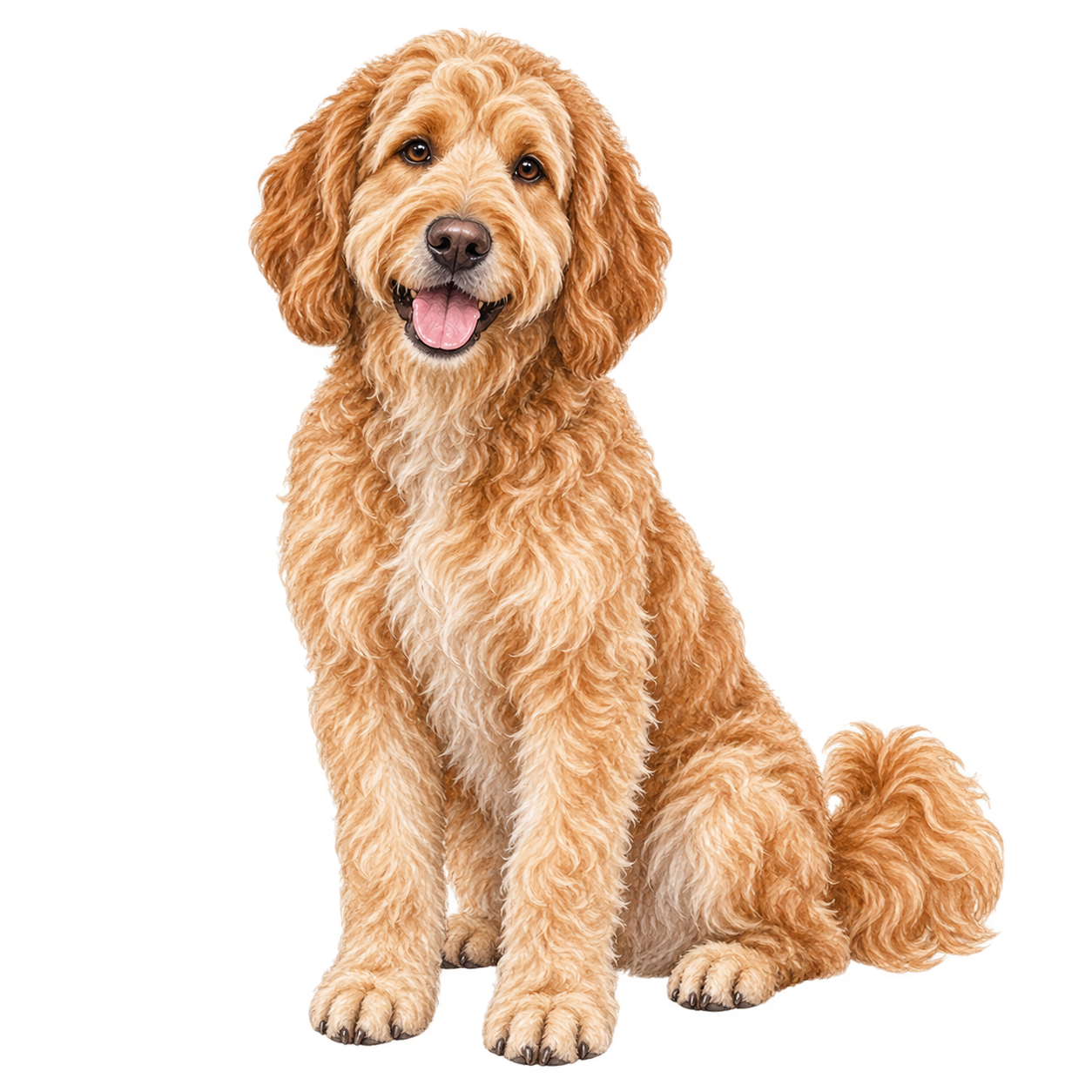
Crossbreeds
Labradoodle
Friendly, bright and bouncy — a Lab’s heart with a Poodle’s coat (often).
Labradoodles blend the outgoing Labrador with the clever, low-shedding Poodle. They tend to be affectionate, energetic family dogs, but size, coat and temperament vary, and they need regular professional grooming.
A Labrador Retriever × Poodle cross. Not recognised by the AKC. Australian Labradoodles are a separate multigenerational type that also includes Cocker Spaniel lines.
Parent breeds: Labrador Retriever × Poodle
- Height
- 14–24 in36–61 cm
- Weight
- 15–65 lb7–29 kg
- Life expectancy
- 12–15 years
- Size
- Medium
- Group
- Crossbreeds
- Origin
- Australia
Coat: Hair, fleece or wool coat; shedding varies. Colours: Cream, Chalk, Apricot, Red, Chocolate, Black, Caramel, Parti.
At a glance
Ratings describe typical dogs of the breed on a 1–5 scale. Individual dogs vary with lines, upbringing and training.
Temperament
Labradoodles are usually friendly, playful and eager to please, with a love of people and other dogs. They are quick learners and enjoy games, swimming and retrieving.
They can be very energetic and excitable, especially in adolescence, and are prone to jumping up. As a cross, individuals can lean more Lab or more Poodle in personality.
Varieties
- Miniature
- Around 14–16 in and 15–25 lb.
- Medium
- Around 17–20 in and 30–45 lb.
- Standard
- Around 21–24 in and 50–65 lb.
Living with a Labradoodle
Exercise
Needs 60–90 minutes daily for standards; less for minis. Loves fetch and swimming.
Grooming
Brush several times a week and book professional grooming every six to eight weeks. Fleece and wool coats mat easily.
Training
Very trainable and food-motivated. Prioritise calm greetings and loose-lead walking.
Kids & other pets
Excellent with children and other pets. Adolescents jump and mouth, so teach calm greetings early and supervise play with toddlers.
Time alone
People-oriented and prone to separation stress. Build alone time gradually from puppyhood and use food puzzles for longer absences.
Home fit
Best suited to a house with secure outdoor space; apartment living is hard on this breed and its neighbours.
Is a Labradoodle right for you?
Take the Breed Fit quiz to see how a Labradoodle matches your home, schedule and tolerance for shedding, barking and exercise — or find out which breed matches your personality with Dogsona.
Health
With good breeding and care, a Labradoodle typically lives 12–15 years. These are the conditions most associated with the breed — not a prediction for any individual dog.
Hip and elbow dysplasia
Inherited from both parent breeds; screened parents help.
Progressive retinal atrophy
Found in both Labs and Poodles; DNA testing is available.
Exercise-induced collapse
Inherited from Labrador lines; DNA testing identifies carriers.
Ear infections
Hairy ears trap moisture; clean them regularly.
Addison’s disease
Seen in Standard Poodle lines.
Ask a breeder for
- Both parents: hip and elbow evaluation
- Both parents: eye examination
- DNA tests: prcd-PRA, EIC, von Willebrand disease
Sources: OFA health testing guidance for Labrador Retriever and Poodle; Australian Labradoodle Association of America. This is general information, not veterinary advice — talk to your vet about your own dog.
Cost to own
After the first year, expect roughly $1,200–$2,500 a year for food, routine vet care, preventives, insurance and supplies (US estimate).
- Professional grooming every 6–8 weeks adds roughly $500–$900 a year.
- Pet insurance for a puppy typically runs $30–$60 a month; premiums rise with age and breed risk.
History
Wally Conron of the Royal Guide Dogs Association of Australia bred the first well-known Labradoodles in 1989, seeking a guide dog for a blind woman whose husband was allergic to dogs. Conron later said he regretted the craze that followed.
Australian breeders developed multigenerational Australian Labradoodles in the 1990s, adding Cocker Spaniel lines to stabilise coat and temperament. Labradoodles are now bred worldwide in many sizes.
Did you know?
- The first famous Labradoodle, Sultan, became a guide dog in Hawaii.
- Wally Conron later called the Labradoodle craze his “life’s regret”.
- Australian Labradoodles often include Cocker Spaniel ancestry.
Library guides for Labradoodle owners
Grooming
Brushing
Labradoodle coats mat without regular brushing.
Grooming
Bathing
How to bath a Labradoodle without drying out the coat.
Training
Heel and Loose-Leash Walking
A strong Labradoodle needs loose-lead manners early.
Exercise & Play
Fetch
A fast way to meet a high exercise need.
Exercise & Play
Hide and Seek
Brain work that tires busy minds.
Exercise & Play
Tug of War
An energy outlet that also builds impulse control.
Similar breeds
Frequently asked questions
- Are Labradoodles hypoallergenic?
- No dog is truly hypoallergenic, though many Labradoodles shed less than a Labrador.
- How big do Labradoodles get?
- Minis weigh around 15–25 lb, mediums 30–45 lb and standards 50–65 lb.
- Labradoodle or Goldendoodle?
- Both are friendly and trainable. Labradoodles can be slightly more energetic; Goldendoodles may be a little softer.