Crossbreeds
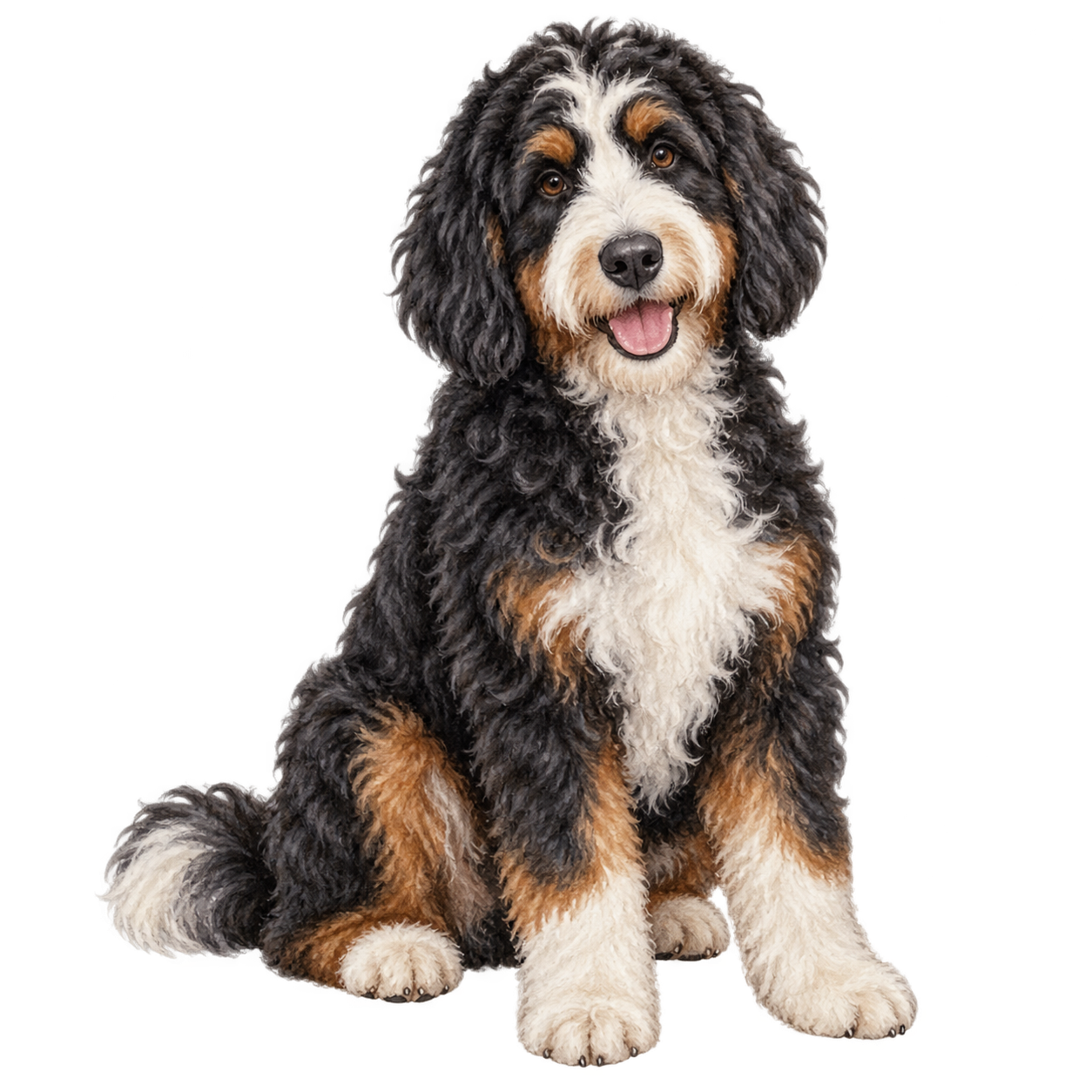
Bernedoodle
Goofy, affectionate and fluffy — Berner warmth with a Poodle coat (usually).
Bernedoodles combine the gentle, family-oriented Bernese Mountain Dog with the clever, lower-shedding Poodle. They come in tiny, mini and standard sizes and tend to be affectionate and playful, with grooming needs that are easy to underestimate.
A Bernese Mountain Dog × Poodle cross. Not recognised by the AKC; size, coat and temperament vary more than in a purebred.
Parent breeds: Bernese Mountain Dog × Poodle
- Height
- 12–29 in30–74 cm
- Weight
- 10–90 lb5–41 kg
- Life expectancy
- 10–15 years
- Size
- Large
- Group
- Crossbreeds
- Origin
- Canada
Coat: Wavy to curly, low- to moderate-shedding coat. Colours: Tricolour, Black and white, Black, Merle, Sable.
At a glance
Ratings describe typical dogs of the breed on a 1–5 scale. Individual dogs vary with lines, upbringing and training.
Temperament
Most Bernedoodles are sociable, clownish and closely bonded to their family, with the Berner’s gentleness and the Poodle’s quick mind. They often do well with children and other dogs and are usually friendly with visitors.
Some inherit Berner stubbornness or Poodle sensitivity, and adolescents can be bouncy and mouthy. As a cross, temperament is less predictable than in either parent, so meet the parents and ask about their temperaments.
Varieties
- Tiny
- Around 12–17 in and 10–24 lb, from a Toy Poodle parent (usually via a mini Bernedoodle).
- Mini
- Around 18–22 in and 25–49 lb, from a Miniature Poodle parent.
- Standard
- Around 23–29 in and 70–90 lb, from a Standard Poodle parent.
Living with a Bernedoodle
Exercise
Standards need about an hour daily; minis and tinies 30–60 minutes. Many inherit the Berner’s heat sensitivity, so exercise in cool parts of the day.
Grooming
Brush to the skin several times a week and book professional grooming every six to eight weeks. Wavy and curly coats mat quickly, especially behind the ears and under the legs.
Training
Generally responsive to reward-based training, with occasional stubbornness. Start loose-lead walking early in standards — they grow large fast.
Kids & other pets
Usually excellent with children and other pets. Supervise large, bouncy puppies around toddlers.
Time alone
People-oriented and prone to separation stress. Build alone time gradually.
Home fit
Best suited to a house with secure outdoor space; apartment living is hard on this breed and its neighbours.
Is a Bernedoodle right for you?
Take the Breed Fit quiz to see how a Bernedoodle matches your home, schedule and tolerance for shedding, barking and exercise — or find out which breed matches your personality with Dogsona.
Health
With good breeding and care, a Bernedoodle typically lives 10–15 years. These are the conditions most associated with the breed — not a prediction for any individual dog.
Hip and elbow dysplasia
Inherited from both parent breeds; screened parents reduce the risk.
Cancer
Bernese Mountain Dogs have very high cancer rates; crossbreeding may reduce but not remove the risk.
Degenerative myelopathy
Found in Bernese lines; DNA testing is available.
Addison’s disease and sebaceous adenitis
Conditions seen in Standard Poodles.
Ear infections
Hairy, floppy ears trap moisture; clean them regularly.
Ask a breeder for
- Both parents: hip and elbow evaluation
- Both parents: eye examination and cardiac exam
- DNA tests: degenerative myelopathy, von Willebrand disease, prcd-PRA
Sources: OFA health testing guidance for Bernese Mountain Dog and Poodle; Berner-Garde Foundation. This is general information, not veterinary advice — talk to your vet about your own dog.
Cost to own
After the first year, expect roughly $1,500–$3,000 a year for food, routine vet care, preventives, insurance and supplies (US estimate).
- Professional grooming every 6–8 weeks adds roughly $500–$900 a year.
- Food, medication and anaesthesia are dosed by weight, so every vet visit costs more for a big dog.
- Pet insurance for a puppy typically runs $30–$60 a month; premiums rise with age and breed risk.
History
Sherry Rupke of SwissRidge Kennels in Ontario is credited with deliberately breeding the first Bernedoodles in 2003, aiming for a family dog with Berner temperament, longer life expectancy and a lower-shedding coat.
Demand grew alongside the Goldendoodle and Labradoodle boom. Breeders now produce first-generation (F1), backcrossed (F1B) and multigenerational dogs; backcrosses to the Poodle generally shed less.
Did you know?
- Tricolour Bernedoodles often closely resemble a fluffy Bernese Mountain Dog.
- The first deliberate Bernedoodle litters were bred in 2003.
- Coat type (straight, wavy or curly) is inherited largely through a single gene, and DNA tests can predict it.
Library guides for Bernedoodle owners
Grooming
Brushing
Bernedoodle coats mat without regular brushing.
Grooming
Bathing
How to bath a Bernedoodle without drying out the coat.
Training
Heel and Loose-Leash Walking
A strong Bernedoodle needs loose-lead manners early.
Grooming
Ear Cleaning
Ear care matters for this coat and ear type.
Exercise & Play
Dog Walking
Getting daily walks right for a Bernedoodle.
Grooming
Nail Clipping
Every dog needs regular nail care.
Similar breeds
Frequently asked questions
- Are Bernedoodles hypoallergenic?
- No dog is truly hypoallergenic. F1B and multigenerational Bernedoodles usually shed less, which some allergy sufferers tolerate better.
- How big do Bernedoodles get?
- Tiny Bernedoodles weigh about 10–24 lb, minis 25–49 lb and standards 70–90 lb.
- Do Bernedoodles live longer than Bernese Mountain Dogs?
- Often, yes — mini and tiny sizes especially. Standards typically live 10–12 years.