Crossbreeds
Goldendoodle
Friendly, clever and fluffy — the Golden’s warmth with a Poodle’s brain.
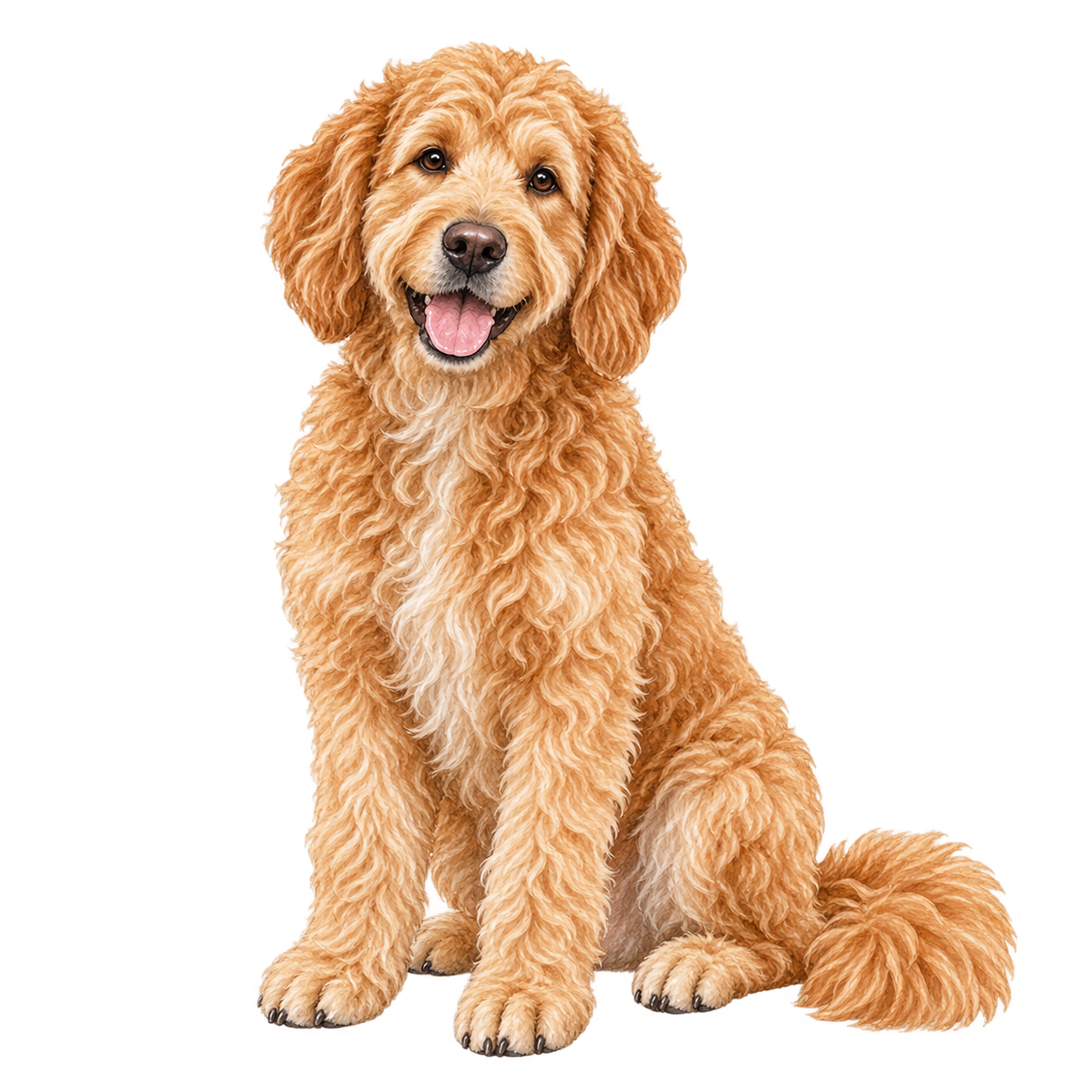
Goldendoodles combine the sociable Golden Retriever with the intelligent Poodle. They are usually friendly, trainable family dogs, but coat type, size and energy vary widely, and grooming needs are substantial.
A Golden Retriever × Poodle cross. Not recognised by the AKC; size, coat and temperament vary more than in a purebred.
Parent breeds: Golden Retriever × Poodle
- Height
- 13–24 in33–61 cm
- Weight
- 15–90 lb7–41 kg
- Life expectancy
- 10–15 years
- Size
- Medium
- Group
- Crossbreeds
- Origin
- United States and Australia
Coat: Straight, wavy or curly; shedding varies by generation. Colours: Cream, Apricot, Red, Gold, Chocolate, Black, Parti, Merle.
At a glance
Ratings describe typical dogs of the breed on a 1–5 scale. Individual dogs vary with lines, upbringing and training.
Temperament
Most Goldendoodles are affectionate, outgoing and eager to please. They tend to welcome visitors, enjoy other dogs and do well with children. Many love water and retrieving.
Both parent breeds are energetic and mouthy when young, and doodles are often bouncy adolescents. They are people-oriented and may struggle with long periods alone. As a cross, temperament depends heavily on the parents.
Varieties
- Mini
- Around 13–20 in and 15–35 lb.
- Medium
- Around 17–21 in and 35–50 lb.
- Standard
- Around 20–24 in and 50–90 lb.
Living with a Goldendoodle
Exercise
About an hour daily for standards; 30–60 minutes for minis. Many enjoy swimming and fetch.
Grooming
Brush to the skin several times a week and book professional grooming every six to eight weeks. Doodle coats mat easily, especially behind the ears and in the armpits.
Training
Very trainable with reward-based methods. Teach calm greetings and loose-lead walking early.
Kids & other pets
Usually excellent with children and other pets. Supervise bouncy, fast-growing standard puppies around toddlers and teach them not to jump up.
Time alone
People-focused; build alone time gradually to prevent separation distress.
Home fit
Can manage in an apartment with committed daily exercise; a house with outdoor space is easier.
Is a Goldendoodle right for you?
Take the Breed Fit quiz to see how a Goldendoodle matches your home, schedule and tolerance for shedding, barking and exercise — or find out which breed matches your personality with Dogsona.
Health
With good breeding and care, a Goldendoodle typically lives 10–15 years. These are the conditions most associated with the breed — not a prediction for any individual dog.
Hip and elbow dysplasia
Inherited from both parent breeds; screened parents help.
Ear infections
Hairy, floppy ears trap moisture. Clean and dry them regularly.
Subvalvular aortic stenosis (SAS)
A heart defect found in Golden Retrievers.
Progressive retinal atrophy
Inherited from either parent; DNA tests are available.
Skin allergies
Common in doodles; managed with diet and vet care.
Ask a breeder for
- Both parents: hip and elbow evaluation
- Both parents: eye and cardiac examinations
- DNA tests: prcd-PRA, GR-PRA1/2, von Willebrand disease
Sources: OFA health testing guidance for Golden Retriever and Poodle; Golden Retriever Club of America; Poodle Club of America. This is general information, not veterinary advice — talk to your vet about your own dog.
Cost to own
After the first year, expect roughly $1,200–$2,500 a year for food, routine vet care, preventives, insurance and supplies (US estimate).
- Professional grooming every 6–8 weeks adds roughly $500–$900 a year.
- Pet insurance for a puppy typically runs $30–$60 a month; premiums rise with age and breed risk.
History
Goldendoodles became popular in the 1990s, following the success of the Labradoodle, as breeders sought a friendly retriever temperament with a lower-shedding coat.
Breeders now produce F1 (first-generation), F1B (backcrossed to Poodle) and multigenerational doodles. There is no single standard, so size and coat vary even within litters.
Did you know?
- Coat type in doodles is predictable with DNA tests for the curl and furnishings genes.
- F1B doodles (backcrossed to the Poodle) usually shed the least.
- Goldendoodles come in more sizes than most purebreds.
Library guides for Goldendoodle owners
Grooming
Brushing
Goldendoodle coats mat without regular brushing.
Grooming
Bathing
How to bath a Goldendoodle without drying out the coat.
Exercise & Play
Tug of War
An energy outlet that also builds impulse control.
Grooming
Ear Cleaning
Ear care matters for this coat and ear type.
Exercise & Play
Dog Walking
Getting daily walks right for a Goldendoodle.
Grooming
Nail Clipping
Every dog needs regular nail care.
Similar breeds
Frequently asked questions
- Are Goldendoodles hypoallergenic?
- No dog is truly hypoallergenic. Some doodles shed very little, but this varies by generation and individual.
- How big do Goldendoodles get?
- Minis weigh around 15–35 lb, mediums 35–50 lb and standards 50–90 lb.
- Are Goldendoodles good family dogs?
- Yes — they are typically friendly, playful and good with children.