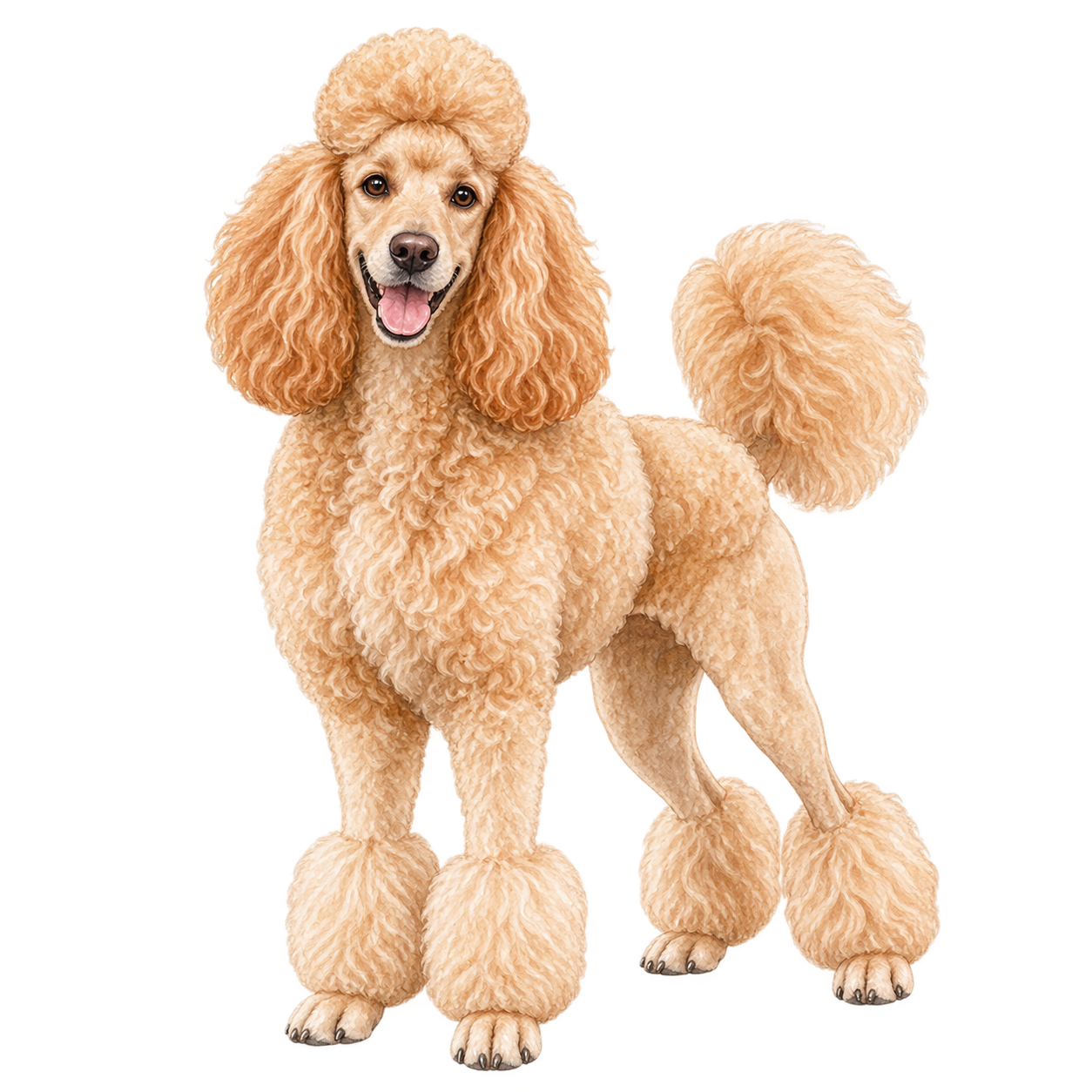
Non-Sporting group
Poodle
Brilliant, athletic and low-shedding — far more dog than the haircut suggests.
Poodles are among the most intelligent and trainable breeds, available in three sizes that share one standard. They are active, sensitive and people-oriented, shed very little and need professional grooming every few weeks.
The AKC places Standard and Miniature Poodles in the Non-Sporting Group and Toy Poodles in the Toy Group.
- Height
- 9–24 in23–61 cm
- Weight
- 4–70 lb2–32 kg
- Life expectancy
- 10–18 years
- Size
- Medium
- Group
- Non-Sporting
- Origin
- Germany, developed in France
Coat: Dense, curly, low-shedding single coat. Colours: Black, White, Apricot, Red, Silver, Blue, Brown, Cream, Grey, Café au lait.
At a glance
Ratings describe typical dogs of the breed on a 1–5 scale. Individual dogs vary with lines, upbringing and training.
Temperament
Poodles are quick learners, responsive to their owners and often a little reserved with strangers until introduced. They enjoy training, games and new challenges, and they read household moods closely. Standards in particular have a goofy, playful side and real retrieving instinct.
That intelligence needs an outlet. Under-stimulated Poodles can become anxious, vocal or clever in unhelpful ways, and the smaller varieties can be sensitive to rough handling. Early socialisation helps them become confident rather than aloof.
Varieties
- Standard
- Over 15 in at the shoulder, usually 40–70 lb. An athletic, sturdy retriever with the most exercise need.
- Miniature
- 10–15 in, roughly 10–15 lb. Busy, clever and adaptable to smaller homes.
- Toy
- 10 in or under, about 4–6 lb. A delicate companion that still needs training and mental work.
Living with a Poodle
Exercise
Standards need an hour or more a day and love swimming, retrieving and dog sports. Miniatures and Toys need 30–60 minutes of walks and play, plus daily brain work.
Grooming
The coat grows continuously and mats if neglected. Brush to the skin several times a week and book a professional clip every four to eight weeks. Keep ears clean and dry.
Training
Exceptionally trainable with reward-based methods. They excel at obedience, agility and tricks, and they get bored with repetition — keep sessions varied.
Kids & other pets
Standards are excellent with children. Toys are fragile and better with older, gentle kids. Poodles usually get on well with other pets when raised with them.
Time alone
They bond closely and can struggle with long daily absences. Build alone time gradually and leave puzzle toys.
Home fit
Can manage in an apartment with committed daily exercise; a house with outdoor space is easier.
Is a Poodle right for you?
Take the Breed Fit quiz to see how a Poodle matches your home, schedule and tolerance for shedding, barking and exercise — or find out which breed matches your personality with Dogsona.
Health
With good breeding and care, a Poodle typically lives 10–18 years. These are the conditions most associated with the breed — not a prediction for any individual dog.
Addison’s disease
An adrenal disorder seen more often in Standard Poodles; symptoms are vague, so mention the breed risk to your vet.
Sebaceous adenitis
An inherited inflammatory skin condition in Standards, causing scaling and hair loss.
Gastric dilatation-volvulus (bloat)
A risk for deep-chested Standards; learn the signs and consider smaller meals.
Patellar luxation and Legg-Calvé-Perthes disease
Kneecap and hip problems common in Miniatures and Toys.
Progressive retinal atrophy (prcd-PRA)
Inherited vision loss in the smaller varieties; parents should be DNA tested.
Ask a breeder for
- Standard: hip evaluation, eye exam, and sebaceous adenitis, thyroid or cardiac screening
- Miniature and Toy: eye exam, prcd-PRA DNA test, patella evaluation (plus hips for Miniatures)
- DNA test for neonatal encephalopathy (Standards)
Sources: OFA CHIC breed requirements: Poodle; Poodle Club of America. This is general information, not veterinary advice — talk to your vet about your own dog.
Cost to own
After the first year, expect roughly $1,200–$2,500 a year for food, routine vet care, preventives, insurance and supplies (US estimate).
- Professional grooming every 6–8 weeks adds roughly $500–$900 a year.
- Pet insurance for a puppy typically runs $30–$60 a month; premiums rise with age and breed risk.
History
The Poodle began as a German water retriever — the name comes from “Pudel”, meaning to splash. The traditional show clip started as a practical working cut, keeping the joints and chest warm while lightening the coat for swimming.
France adopted the breed so thoroughly that it is the national dog, and smaller varieties were bred as truffle hunters, circus performers and companions. The AKC registered its first Poodle in 1887, and the breed topped AKC registrations from 1960 to 1982.
Did you know?
- Poodles have raced the Iditarod: musher John Suter ran a Standard Poodle team in the late 1980s.
- The Poodle is the national dog of France despite its German origins.
- Their coat is often described as hypoallergenic; no dog is allergen-free, but low shedding helps many people.
Library guides for Poodle owners
Grooming
Brushing
Poodle coats mat without regular brushing.
Grooming
Bathing
How to bath a Poodle without drying out the coat.
Exercise & Play
Fetch
A fast way to meet a high exercise need.
Exercise & Play
Hide and Seek
Brain work that tires busy minds.
Exercise & Play
Tug of War
An energy outlet that also builds impulse control.
Grooming
Ear Cleaning
Ear care matters for this coat and ear type.
Similar breeds
Frequently asked questions
- Are Poodles hypoallergenic?
- No dog is truly hypoallergenic, but Poodles shed very little, which many allergy sufferers tolerate better. Spend time with the breed before committing.
- Which Poodle size is best for a family?
- Standards are the sturdiest and most patient with children. Miniatures suit smaller homes; Toys are best with adults or older kids.
- How often does a Poodle need grooming?
- Brush several times a week and book a professional clip every four to eight weeks.
- Are Poodles smart?
- Yes — they are consistently ranked among the most trainable breeds. They need training and mental work to stay settled.