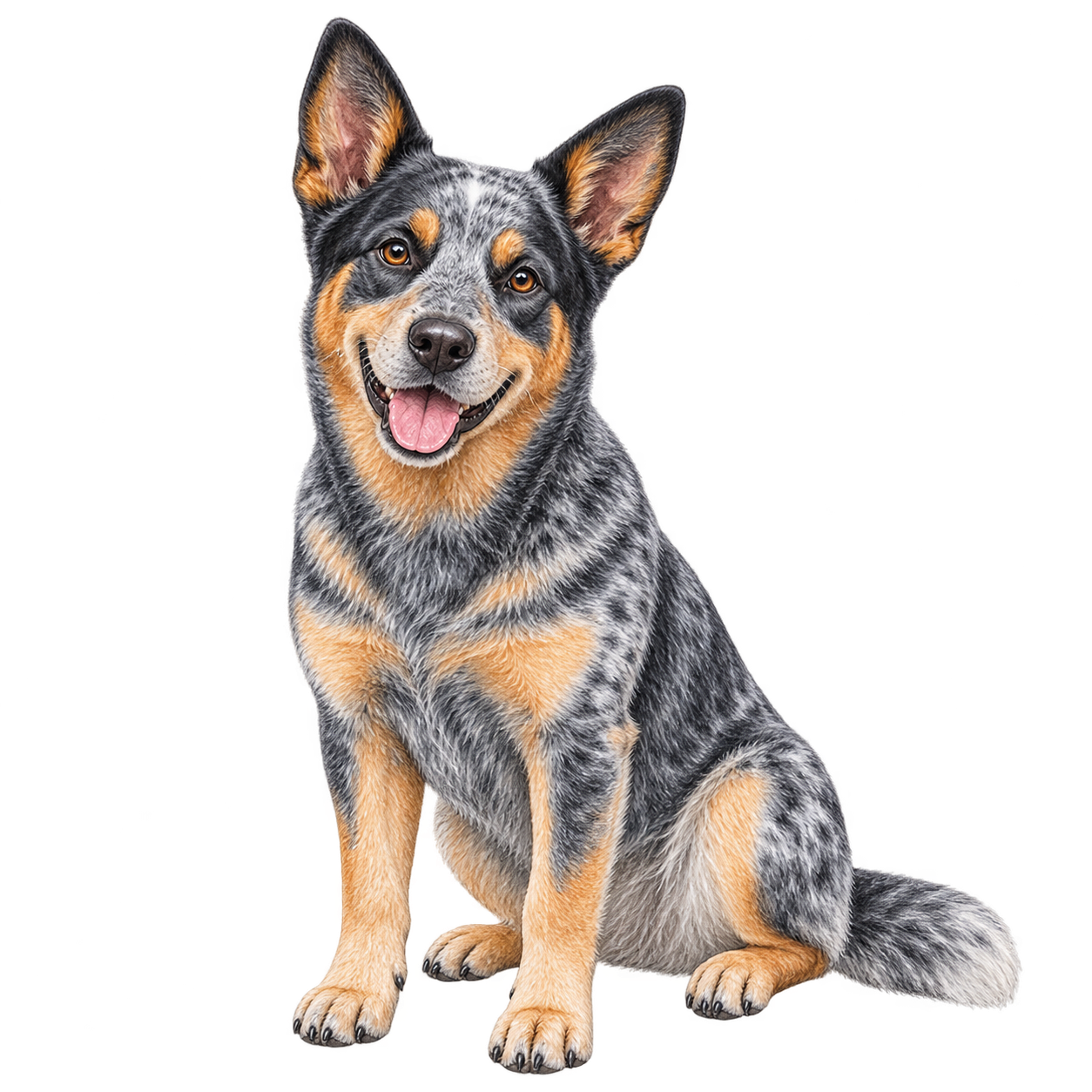
Herding group
Australian Cattle Dog
Tough, tireless and fiercely loyal — a working partner that needs a job.
Australian Cattle Dogs were bred to move stubborn cattle across vast distances in heat. They are intelligent, hardy and devoted to their people, but their energy, nipping instinct and suspicion of strangers make them a poor fit for sedentary homes.
- Height
- 17–20 in43–51 cm
- Weight
- 35–50 lb16–23 kg
- Life expectancy
- 12–16 years
- Size
- Medium
- Group
- Herding
- Origin
- Australia
Coat: Short, dense, weather-resistant double coat. Colours: Blue, Blue mottled, Blue speckled, Red speckled, Red mottled.
At a glance
Ratings describe typical dogs of the breed on a 1–5 scale. Individual dogs vary with lines, upbringing and training.
Temperament
Cattle Dogs are alert, resourceful and bonded tightly to one person or family. They are usually reserved with strangers and protective of home and property. Given work — sport, farm chores, long runs, training — they are focused, clever and a delight.
Their herding style is “heeling”: nipping at the heels of cattle. That instinct transfers to running children, bikes and ankles without training. Under-exercised ACDs become restless, destructive and inventive. They mature slowly and can be headstrong.
Living with a Australian Cattle Dog
Exercise
Needs 90 minutes to two hours of vigorous activity plus mental work daily. Excellent for running, hiking, herding, agility, flyball and disc.
Grooming
Easy weekly brushing, with a heavy coat blow once or twice a year. Keep nails short; working dogs wear them naturally.
Training
Very intelligent but independent. Teach impulse control, a “leave it” for moving things and bite inhibition early. Consistency matters more than repetition — they bore quickly.
Kids & other pets
Loyal with their own family, but nipping and herding behaviour need management around young children. Can be bossy with other dogs; strong prey drive toward cats and small animals unless raised together.
Time alone
Copes with alone time only if exercised first. Boredom produces chewing, digging and escape attempts.
Home fit
Best suited to a house with secure outdoor space; apartment living is hard on this breed and its neighbours.
Is a Australian Cattle Dog right for you?
Take the Breed Fit quiz to see how a Australian Cattle Dog matches your home, schedule and tolerance for shedding, barking and exercise — or find out which breed matches your personality with Dogsona.
Health
With good breeding and care, a Australian Cattle Dog typically lives 12–16 years. These are the conditions most associated with the breed — not a prediction for any individual dog.
Hip dysplasia
Screen parents and keep dogs lean and fit.
Congenital deafness
Linked to the white-based coat; BAER testing identifies affected puppies.
Progressive retinal atrophy (prcd-PRA)
Inherited vision loss detectable by DNA test.
Primary lens luxation
The lens dislocates, causing pain and glaucoma; DNA testing is available.
Osteoarthritis
Hard-working dogs often develop joint wear in later life.
Ask a breeder for
- Hip and elbow evaluation
- BAER hearing test
- Eye examination and DNA tests for prcd-PRA and primary lens luxation
Sources: OFA CHIC breed requirements: Australian Cattle Dog; Australian Cattle Dog Club of America. This is general information, not veterinary advice — talk to your vet about your own dog.
Cost to own
After the first year, expect roughly $1,200–$2,500 a year for food, routine vet care, preventives, insurance and supplies (US estimate).
- Pet insurance for a puppy typically runs $30–$60 a month; premiums rise with age and breed risk.
History
In the 1800s Australian ranchers needed a dog that could handle half-wild cattle over long drives in harsh conditions. Drovers crossed imported collie-type herding dogs with the native dingo, later adding Dalmatian and Black and Tan Kelpie. Thomas Hall and later Jack and Harry Bagust are credited with key early breeding.
Robert Kaleski wrote the first standard in 1903. The breed helped build Queensland’s beef industry — hence “Queensland Heeler” — and the AKC recognised it in 1980.
Did you know?
- An Australian Cattle Dog named Bluey was long recognised by Guinness as the oldest dog on record, at 29 years.
- Puppies are born white and develop their blue or red coats over weeks — a legacy of Dalmatian ancestry.
- Many Cattle Dogs have a white “Bentley mark” on the forehead.
Library guides for Australian Cattle Dog owners
Training
Come (Recall)
High chase drive makes a reliable recall essential.
Training
Heel and Loose-Leash Walking
A strong Australian Cattle Dog needs loose-lead manners early.
Exercise & Play
Fetch
A fast way to meet a high exercise need.
Exercise & Play
Dog Road Work
Structured conditioning for high-stamina dogs.
Exercise & Play
Hide and Seek
Brain work that tires busy minds.
Training
Place / Go to Mat
Teaching a settle helps dogs that struggle to switch off.
Similar breeds
Frequently asked questions
- Are Australian Cattle Dogs good family pets?
- For active families who can give them work, yes. They need training to stop heel-nipping around children.
- Do Blue Heelers bark a lot?
- They are usually watchful rather than constant barkers, but boredom increases barking.
- How long do Australian Cattle Dogs live?
- Typically 12 to 16 years — long for a medium-sized dog.