Sporting group
German Wirehaired Pointer
A rugged, all-terrain hunting dog — loyal, driven and ready for any weather.
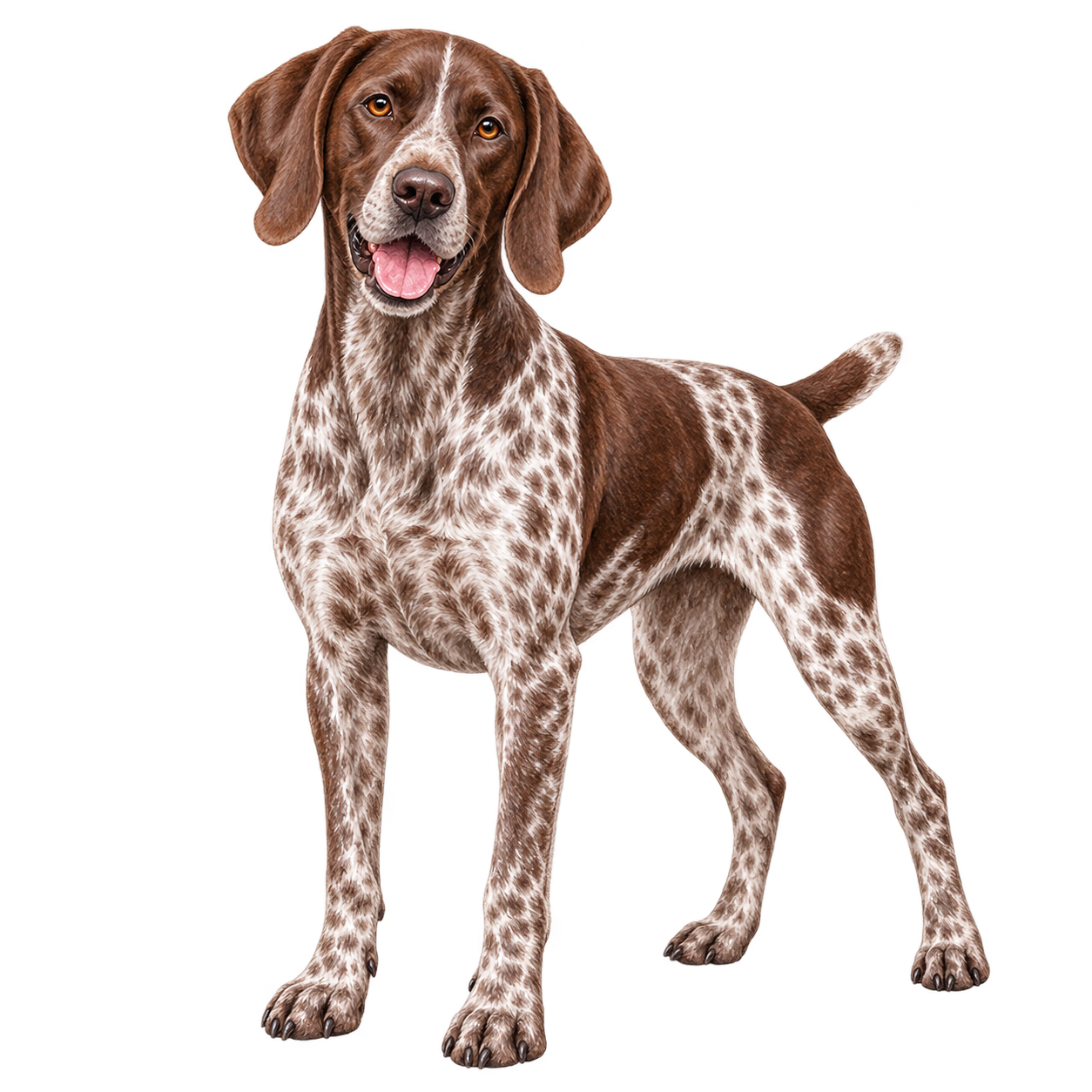
German Wirehaired Pointers are versatile hunting dogs with a harsh, weatherproof coat and a strong work ethic. They are loyal to their family and often aloof with strangers, and they need an active owner and a lot of exercise.
- Height
- 22–26 in56–66 cm
- Weight
- 50–70 lb23–32 kg
- Life expectancy
- 14–16 years
- Size
- Large
- Group
- Sporting
- Origin
- Germany
Coat: Harsh, wiry, weather-resistant outer coat with a beard and eyebrows. Colours: Liver and white, Liver roan, Solid liver, Black roan.
At a glance
Ratings describe typical dogs of the breed on a 1–5 scale. Individual dogs vary with lines, upbringing and training.
Temperament
GWPs are affectionate with their family, loyal and eager to work. They are often reserved with strangers and can be protective. Many bond strongly with one person.
Their hunting drive is intense, and they can be dominant with other dogs or chase cats and small animals. Without enough work they become restless and destructive. Firm, fair, consistent training is important.
Living with a German Wirehaired Pointer
Exercise
Needs two hours of vigorous activity daily. Ideal for hunters, runners and hikers.
Grooming
Brush weekly and hand-strip occasionally. Check the beard, ears and paws after outings.
Training
Intelligent but independent. Consistent, positive training and early socialisation are key. Recall needs work.
Kids & other pets
Loyal with their own children, though boisterous. Often best as the only dog or with opposite-sex dogs; high prey drive.
Time alone
Struggles with long periods alone and may become destructive without exercise.
Home fit
Best suited to a house with secure outdoor space; apartment living is hard on this breed and its neighbours.
Is a German Wirehaired Pointer right for you?
Take the Breed Fit quiz to see how a German Wirehaired Pointer matches your home, schedule and tolerance for shedding, barking and exercise — or find out which breed matches your personality with Dogsona.
Health
With good breeding and care, a German Wirehaired Pointer typically lives 14–16 years. These are the conditions most associated with the breed — not a prediction for any individual dog.
Hip and elbow dysplasia
Screened parents reduce the risk of joint disease.
Von Willebrand disease
An inherited bleeding disorder; a DNA test is available.
Hypothyroidism
An underactive thyroid; managed with daily medication.
Eye disease
Entropion and other eye conditions occur; annual eye exams help.
Ask a breeder for
- Hip and elbow evaluation
- Eye examination
- Cardiac examination
- DNA test for von Willebrand disease
Sources: OFA CHIC breed requirements: German Wirehaired Pointer; German Wirehaired Pointer Club of America. This is general information, not veterinary advice — talk to your vet about your own dog.
Cost to own
After the first year, expect roughly $1,500–$3,000 a year for food, routine vet care, preventives, insurance and supplies (US estimate).
- Food, medication and anaesthesia are dosed by weight, so every vet visit costs more for a big dog.
- Pet insurance for a puppy typically runs $30–$60 a month; premiums rise with age and breed risk.
History
German hunters in the late 1800s wanted a rugged, versatile dog that could point, track and retrieve in thick cover and cold water. They combined pointers, Pudelpointers, Griffons and Stichelhaars to create the Deutsch Drahthaar.
The Drahthaar became Germany’s most popular gundog. American hunters brought it to the United States in the 1920s, and the AKC recognised the German Wirehaired Pointer in 1959.
Did you know?
- The Deutsch Drahthaar is one of the most popular hunting dogs in Germany.
- The GWP’s beard and eyebrows protect its face in thick brush.
- The breed is a true all-rounder: pointing, tracking and retrieving on land and water.
Library guides for German Wirehaired Pointer owners
Training
Come (Recall)
High chase drive makes a reliable recall essential.
Exercise & Play
Fetch
A fast way to meet a high exercise need.
Exercise & Play
Dog Road Work
Structured conditioning for high-stamina dogs.
Exercise & Play
Hide and Seek
Brain work that tires busy minds.
Training
Place / Go to Mat
Teaching a settle helps dogs that struggle to switch off.
Exercise & Play
Tug of War
An energy outlet that also builds impulse control.
Similar breeds
Frequently asked questions
- Are German Wirehaired Pointers good family dogs?
- Yes, for active families. They are loyal but need lots of exercise and training.
- Do GWPs shed?
- Lightly to moderately. The wiry coat is relatively easy to maintain.
- GWP vs German Shorthaired Pointer?
- GWPs have a wiry coat, are often more reserved and protective, and can be more strong-willed.