Working group
Doberman Pinscher
Sleek, loyal and fearless — a sensitive guardian that loves its people.
Dobermans are athletic, intelligent protection dogs with a surprisingly affectionate side. They are highly trainable and deeply devoted, but need daily exercise, structured training and vigilant heart screening.
- Height
- 24–28 in61–71 cm
- Weight
- 60–100 lb27–45 kg
- Life expectancy
- 10–12 years
- Size
- Large
- Group
- Working
- Origin
- Germany
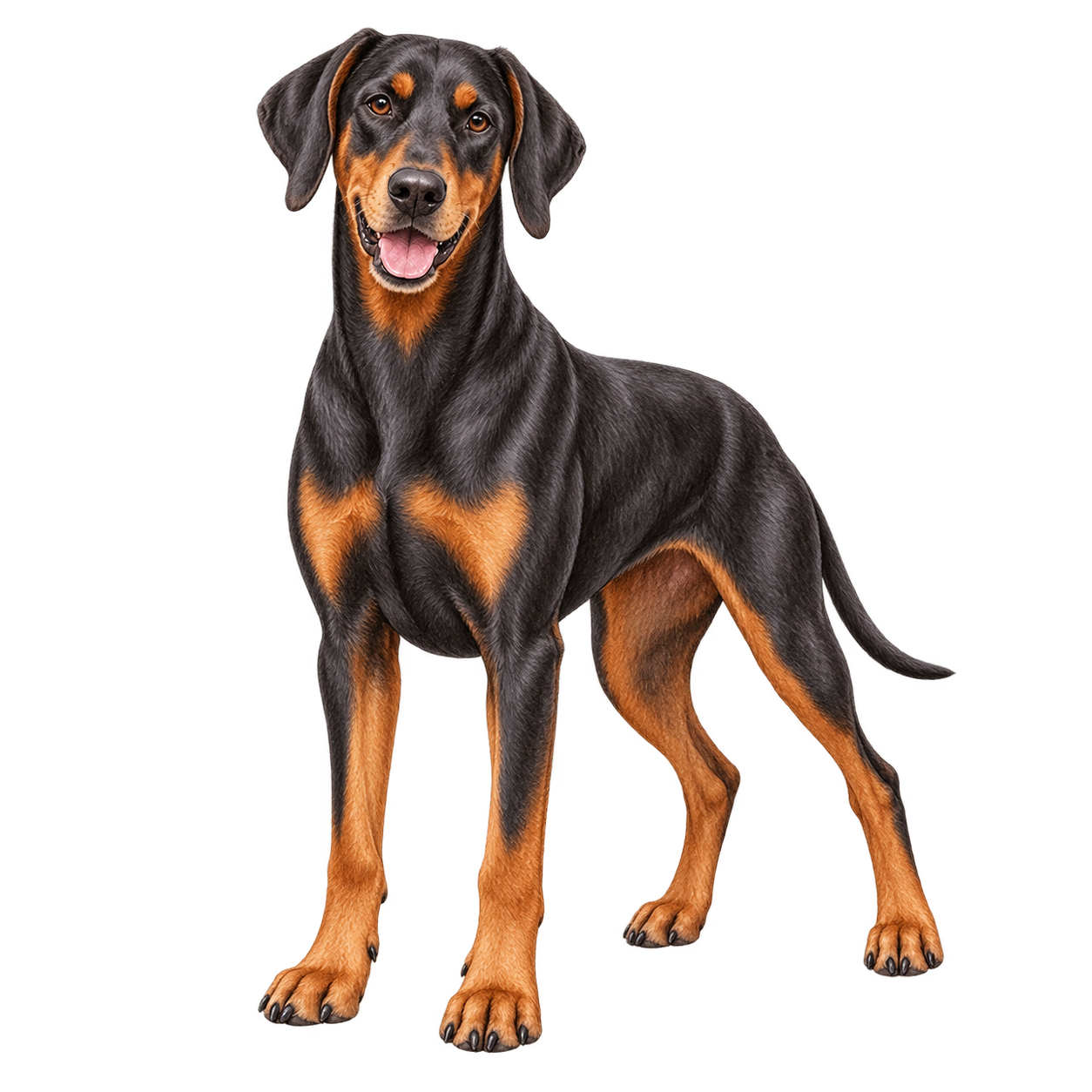
Coat: Short, hard, close-lying coat. Colours: Black and rust, Red and rust, Blue and rust, Fawn and rust.
At a glance
Ratings describe typical dogs of the breed on a 1–5 scale. Individual dogs vary with lines, upbringing and training.
Temperament
Dobermans are alert, confident and bonded closely to their family — many are true “velcro dogs”. They are naturally protective and discerning with strangers, yet often soft and cuddly at home.
They are sensitive and do not respond well to harsh handling. Without enough exercise and training they can become anxious or pushy. Early socialisation helps them become steady rather than suspicious.
Living with a Doberman Pinscher
Exercise
At least an hour of vigorous exercise daily plus training. Excellent for running, obedience and protection sports.
Grooming
Minimal: weekly brushing and nail care. Their thin coat means they feel the cold.
Training
Very trainable and eager to work. Start socialisation early and keep training consistent through adolescence.
Kids & other pets
Loving and protective with their own children; supervise with young kids due to size and energy. Can be same-sex dog selective.
Time alone
Dobermans want to be with their people; long absences can cause anxiety.
Home fit
Best suited to a house with secure outdoor space; apartment living is hard on this breed and its neighbours.
Is a Doberman Pinscher right for you?
Take the Breed Fit quiz to see how a Doberman Pinscher matches your home, schedule and tolerance for shedding, barking and exercise — or find out which breed matches your personality with Dogsona.
Health
With good breeding and care, a Doberman Pinscher typically lives 10–12 years. These are the conditions most associated with the breed — not a prediction for any individual dog.
Dilated cardiomyopathy (DCM)
A common and often fatal heart disease in the breed. Annual Holter monitoring and echocardiograms are recommended from about age two.
Von Willebrand disease
An inherited bleeding disorder; DNA testing is available.
Wobbler syndrome
Cervical spine compression causing an unsteady gait.
Hypothyroidism
Common in the breed; causes weight gain, lethargy and skin problems and is managed with daily medication.
Gastric dilatation-volvulus (bloat)
A deep-chested breed; learn the warning signs.
Ask a breeder for
- Annual Holter monitor and echocardiogram
- Hip evaluation
- Thyroid and eye evaluation
- DNA tests: von Willebrand disease and DCM markers
Sources: OFA CHIC breed requirements: Doberman Pinscher; Doberman Pinscher Club of America. This is general information, not veterinary advice — talk to your vet about your own dog.
Cost to own
After the first year, expect roughly $1,500–$3,000 a year for food, routine vet care, preventives, insurance and supplies (US estimate).
- Food, medication and anaesthesia are dosed by weight, so every vet visit costs more for a big dog.
- Pet insurance for a puppy typically runs $30–$60 a month; premiums rise with age and breed risk.
History
Karl Friedrich Louis Dobermann, a tax collector and dog-pound keeper in Apolda, Germany, developed the breed in the 1890s as a protector on his rounds. He likely combined the old German Pinscher, Rottweiler, Weimaraner and Manchester Terrier.
Dobermans became prized police and military dogs. The US Marine Corps adopted them as official war dogs in WWII; a Doberman named Kurt is buried at the War Dog Cemetery on Guam. The AKC recognised the breed in 1908.
Did you know?
- The breed was named after its creator, Louis Dobermann.
- Dobermans have a natural undocked tail and floppy ears; cropping and docking are banned in many countries.
- A statue of a Doberman stands on Guam as a memorial to WWII war dogs.
Library guides for Doberman Pinscher owners
Training
Heel and Loose-Leash Walking
A strong Doberman Pinscher needs loose-lead manners early.
Exercise & Play
Fetch
A fast way to meet a high exercise need.
Exercise & Play
Dog Road Work
Structured conditioning for high-stamina dogs.
Exercise & Play
Hide and Seek
Brain work that tires busy minds.
Exercise & Play
Tug of War
An energy outlet that also builds impulse control.
Exercise & Play
Dog Walking
Getting daily walks right for a Doberman Pinscher.
Similar breeds
Frequently asked questions
- Are Dobermans good family dogs?
- Yes, for families who provide training and exercise. They are affectionate and protective.
- Are Dobermans aggressive?
- Well-bred, socialised Dobermans are steady and discerning. They are protective, not aggressive by nature.
- How long do Dobermans live?
- About 10–12 years; heart disease is the main risk.