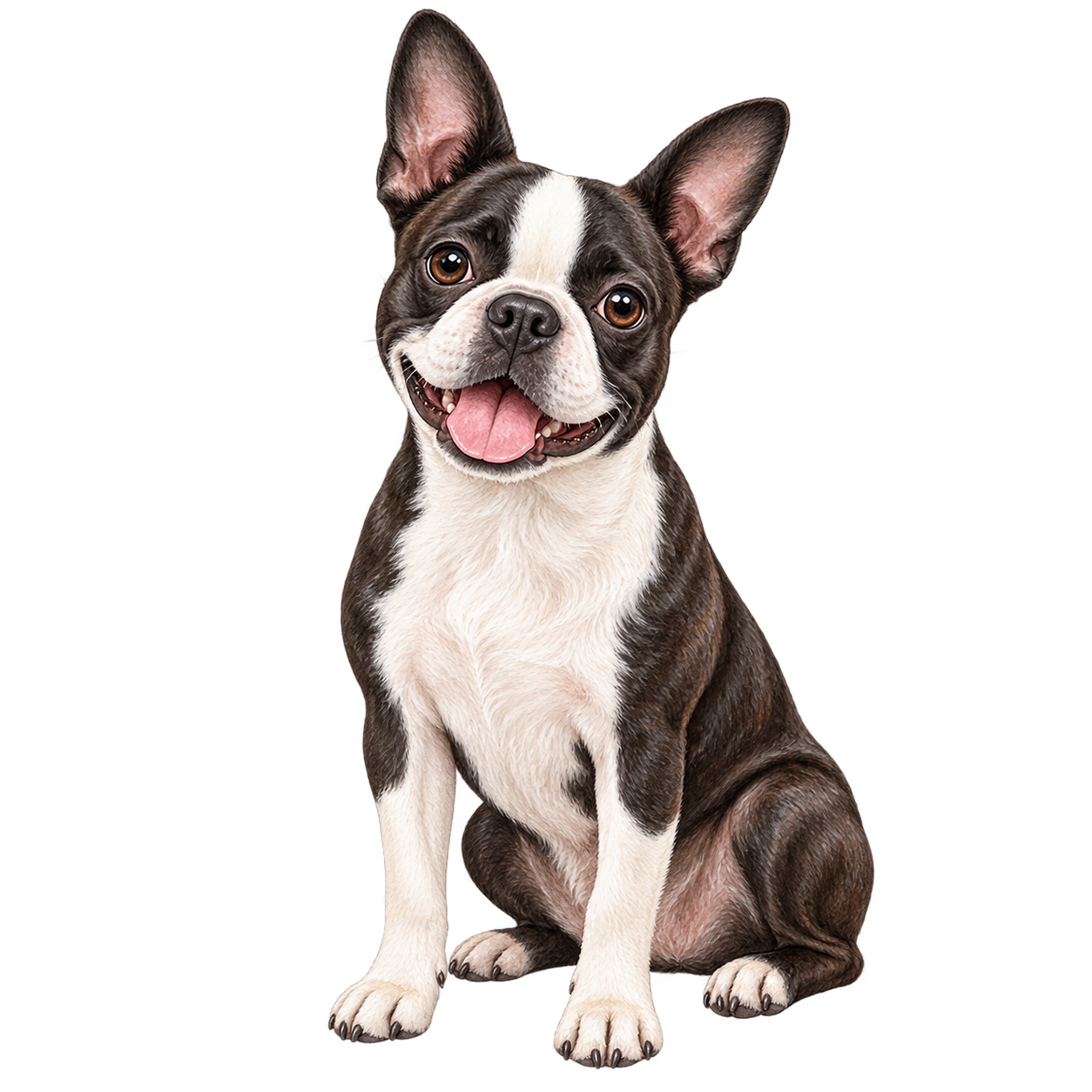
Non-Sporting group
Boston Terrier
The “American Gentleman” — lively, friendly and tuxedo-clad.
Boston Terriers are compact, cheerful companions that adapt well to city life. They are friendly, playful and easy to care for, though their short muzzle and prominent eyes need careful attention.
- Height
- 15–17 in38–43 cm
- Weight
- 12–25 lb5–11 kg
- Life expectancy
- 11–13 years
- Size
- Small
- Group
- Non-Sporting
- Origin
- Boston, United States
Coat: Short, smooth, fine coat. Colours: Black and white, Brindle and white, Seal and white.
At a glance
Ratings describe typical dogs of the breed on a 1–5 scale. Individual dogs vary with lines, upbringing and training.
Temperament
Bostons are affectionate, upbeat and people-focused. They are usually friendly with strangers and other dogs and enjoy games and training. Their size and moderate energy make them adaptable to apartments and families alike.
They can be excitable and occasionally stubborn, and some are sensitive to harsh correction. They generally bark little but make good alert dogs.
Living with a Boston Terrier
Exercise
Around 30–60 minutes of walks and play daily. Avoid hot and humid weather.
Grooming
Minimal: weekly brushing and occasional baths. Wipe facial wrinkles and check eyes daily.
Training
Bright and eager with reward-based training. House-training may take patience. Use a harness to protect the airway.
Kids & other pets
Great with children and usually with other dogs and cats. Sturdy enough for gentle play, though excitable Bostons can nip during rough games.
Time alone
Tolerates a few hours alone once trained, but Bostons are companion dogs and can become vocal or anxious if routinely left for long days.
Home fit
Adapts well to apartments and smaller homes when daily needs are met.
Is a Boston Terrier right for you?
Take the Breed Fit quiz to see how a Boston Terrier matches your home, schedule and tolerance for shedding, barking and exercise — or find out which breed matches your personality with Dogsona.
Health
With good breeding and care, a Boston Terrier typically lives 11–13 years. These are the conditions most associated with the breed — not a prediction for any individual dog.
Brachycephalic obstructive airway syndrome (BOAS)
Snoring and heat intolerance are signs of restricted airways.
Eye injuries and disease
Prominent eyes are prone to corneal ulcers; juvenile cataracts are inherited (HSF4).
Patellar luxation
Kneecaps can slip out of place; ranges from mild to requiring surgery.
Deafness
Linked to white markings; BAER testing detects it.
Spinal malformations
Hemivertebrae are common in screw-tailed breeds.
Ask a breeder for
- Patella evaluation
- Eye examination and HSF4 cataract DNA test
- BAER hearing test
- Cardiac examination
Sources: OFA CHIC breed requirements: Boston Terrier; Boston Terrier Club of America. This is general information, not veterinary advice — talk to your vet about your own dog.
Cost to own
After the first year, expect roughly $1,000–$2,000 a year for food, routine vet care, preventives, insurance and supplies (US estimate).
- Flat-faced breeds often need airway surgery or specialist care; insurance premiums are higher.
- Pet insurance for a puppy typically runs $30–$60 a month; premiums rise with age and breed risk.
History
The breed began around 1870 with Judge, a bulldog-terrier cross bought by Robert C. Hooper of Boston. Judge’s descendants, bred down in size and softened in temperament, became the Boston Terrier.
The AKC recognised the breed in 1893, making it one of the first American-developed breeds in the stud book. It became the official state dog of Massachusetts in 1979.
Did you know?
- Boston University’s mascot, Rhett, is a Boston Terrier.
- The breed’s black-and-white markings earned it the nickname “American Gentleman”.
- Judge, the founding dog, weighed around 32 lb — much heavier than most Bostons today.
Library guides for Boston Terrier owners
Exercise & Play
Dog Walking
Getting daily walks right for a Boston Terrier.
Grooming
Nail Clipping
Every dog needs regular nail care.
New Dog Owners
How to find a reputable dog breeder
What to ask a Boston Terrier breeder about health screening.
New Dog Owners
The real cost of a puppy: what to budget before you bring one home
Budget for the first year and beyond.
Similar breeds



Frequently asked questions
- Are Boston Terriers good apartment dogs?
- Yes — they are small, adaptable and generally quiet.
- Do Boston Terriers shed?
- Lightly. Their short coat needs little grooming.
- Boston Terrier or French Bulldog?
- Bostons are usually lighter, more athletic and longer-legged, with somewhat fewer breathing problems.